top of page
Academic Writing
Journal Articles, Books, Chapters, Proceedings and Other Publications
Proceedings and other publications
6. Söyleşi: Gençlik ve Değişen Müzik Tercihleri | Jun 2022
Journal Articles
Anchor 1
Music and Coffee Houses in the Ottoman–American Diaspora (1890–1940s)
Amerika Osmanlı Diasporasında Müzik ve Kahvehaneler (1890 -1940’lu Yıllar)
Abstract
Ottoman immigration to America, which started in the 1830s, gained momentum, especially in the 1890s and accelerated in the first quarter of the 20th century. People of different nationalities, such as Armenians, Greeks, Arabs, Sephardic Jews, and Turks, were among those who immigrated to America. In addition, immigrants brought with them their cuisine, music, dance, and entertainment cultures as well as their cultural institutions, such as churches, synagogues, coffee houses, and cafés. Coffee houses were the most crucial places where immigrants from the Ottoman geography could socialize. Coffee houses served in many different areas in immigrant life. First, they served as a social support network where the immigrants learned about life in America and solved their problems. Second, they served as an entertainment venue for immigrants. Moreover, music was one of the most popular types of entertainment. This article primarily deals with immigrant musical activities that were held in coffee houses, café amans, and café restaurants. Such musical activities included Karaghiozis performances, listening to records, and live music performances. Similar to music, dance also had an indispensable place in these venues, particularly oriental belly dancing which was one of the principal attractions of immigrant venues.

Anchor 2
The Concept of Beste: Composing in the Context of Creation, Remembering, Finding and Discovering
Bestenin Anlam Dünyası: Yaratma, Hatırlama, Bulma ve Keşfetme Ekseninde Müzik Üretimi
Abstract
The term beste, was borrowed from Persian and has acquired the meaning to create new musical works (i.e., composing) in the Ottoman-Turkish music tradition. Over time, beste has gained widespread use in almost all music genres in Turkey. The aim of this article is to analyze the concept of composition from an ethnomusicological perspective, without resorting to hierarchies. The scope of this article includes terms that are used to define the act of composing (and compositions) in the musics of Turkey, primarily in Turkish Folk and Classical Music. In order to classify and analyze compositions, four methodological questions regarding the nature of the compositions were asked and then answered according to historical and ethnographic data. The first one of these questions is whether the composition is a creation, a finding, a remembrance/recollection, or a discovery. The second question is regarding the number of musicians involved in the process of composing. The third question is how similar the composition is compared to previous compositions. The fourth question is who the real composer of the composition is. As a result of posing these four questions to the concept of composition, an analytical framework was created in the study of compositions.

Anchor 3
Shifts in Sexual Desire: Bans on Dancing Boys (Köçeks) Throughout Ottoman Modernity (1800s–1920s)
Cinsel Arzudaki Değişimler: Osmanlı Modernitesi Boyunca Dans Eden Oğlanlara (Köçeklere) İlişkin Yasaklar (1800'ler-1920'ler)
Abstract
The main objective of this article is to understand the ways in which the köçek (dancing boys) performance became a source of shame and how the practice was subjected to a number of bans in Ottoman Istanbul. In the literature on the köçek, there is a general trend that argues that the practice was banned because of the fights, quarrels and other disputes related to the köçeks and that the practice disappeared altogether no later than 1856. This is what I call the ‘social disorders argument’ and while I acknowledge that history and examine some evidence of social disorders associated with the dancing boys, I also re-analyse the disorders arising from a powerful homoerotic desire that was so common as to even be normative in certain circles in the Ottoman era. In this article, through historical evidence, I show that there are a number of proscriptions against the köçeks. Through a brief history of the bans from the sixteenth century onwards, I show the ways in which the mentality of the bans changed during the Westernization/modernization period and how shame from homoeroticism became a significant determinant in the bans of the nineteenth century.

Books and Chapters
Anchor 1
1. Istanbul of the Orientalists
Şarkiyatçı Edebiyatta İstanbul
Abstract
Konstantinos of Rhodes, an important Byzantine poets of the tenth century, describes Istanbul as “the city the world desires.”1 Geoffroi de Villehardouin, who was a knight in the Crusade armies that occupied Istanbul in 1204, regarded as one of the most important historians of the era, supported what Konstantinos of Rhodes had said.
Over the course of its long history, Istanbul has always been a subject of curiosity, and has been described as a place that nations want to conquer or that those who live outside want to discover. In this context, the history of the city that became an object and center of desire, has been shaped by intensive warfare, sieges and negotiations.

Anchor 2
2. The Image of The Devil in the Ottoman and Islamic World with Respect to Culture, Music and Dance
Osmanlı ve İslam Dünyasında Kültür, Müzik ve Dans Ekseninde Şeytan İmgesi
Abstract
In the broader Ottoman mentality, Satan and other Satainc figures such as peri, cin, hortlak, cadı, vampir had a very significant place in daily life. Figures like Evliya Çelebi, Aşık Paşazade, Ebusuud Efendi and the Arabic and Persian sources that they were influenced by (such as Arabic Fiqh boks and Sheik Sadi-i Shirazi etc.) we see that the image of the devil is described in a very detailed way. In these descriptions, we see the influence of Qur'an and the hadiths, other sacred books, local beliefs, folk religion and mythology. This multicultural image of the devil, of course, represents different faces of evil, and in some cases, it also represents cunningness, vigilance and intelligence. In this context, we see that some Ottoman pashas had the nickname satan (şeytan). A pasha, nicknamed the devil, may then be called Angel because of his good service, or that the pleased Sultan Murad IV called Evliya Çelebi as the devil's apprentice. In spite of these examples, the enemy of the Ottoman state is almost always demonized. In fact, as the enemy, Ottomans were also demonized by the Europeans as well. This international othering and demonization were mainly a result of the wars. On the other hand, we also see similar de-monizing attitudes within the Ottoman society as well. Among them, we find the demonization of Sufis by even more Orthodox theologians. Some Ottoman Muslims were also demonized with totally absurd beliefs (i.e. Gypsies and Kurds were believed by some to be descended from Satan) as well. Music, which had a very significant place in Ottoman life, also had its share of such demonization. Music, dance (raks) and even sema were demoni-zed by Orthodox Islamic figures, even though music was the main part of worship by sects/orders such as Mev-levi, Rufai, Rafizi and Bektashi. In this chapter, the role of demonic figures and their function in the Ottoman culture and music will be analyzed

Anchor 3
3. Political Music in Turkey: The Birth and Diversification of Dissident and Conformist Music (1920–2000)
Türkiye'de Politik Müzik: Muhalif ve Konformist Müziğin Doğuşu ve Çeşitlenmesi (1920–2000)
Abstract
Since the founding of the Turkish republic, music has been viewed and used as a nation-building tool by the state. Respectively, music has also been considered an instrument of opposition from the very beginning. This opposing character has expanded and diversified its vocabulary with a socialist and leftist tone over time, especially in the 1960s. During the end of the decade, we also see the emergence of Kurdish political music. During the early 1970s, Turkey witnessed the burgeoning of the ultranationalist music called Ülkücü music. While the 1980 military coup silenced all the dissident voices and music, musicians who received asylum from European countries continued creating music in exile. Leftist music after the military coup witnessed a popularization in the band music influenced by the Latin American musical genre Nueva canción, and solo musician Ahmet Kaya pioneered the leftist protest song scene. Kurdish political music bands called koms emerged by the end of the 1980s and became more prevalent during the 1990s. The 2000s saw the deradicalization, individualization, and depoliticization of overtly political musics in general. However, with the overpoliticization of the country during the Adalet ve Kalkınma Partisi regime, the dissident elements of protest music have also become dispersed into a wide variety of genres with a more moderate tone.

Anchor 4
4. A Genealogy of Beste (composition) and Its Synonyms in Turkish
Türkçede Bestelemek Anlamına Gelen Kelimeler için bir Şecere Denemesi
Abstract
Beste, a loanword from Persian, is the most commonly used term to denote composition in Turkish and has acquired the meaning of producing new musical works in Istanbul. This article analyzes the vocabulary in Ottoman classical music and Turk-ish folk music with similar meanings to the word beste. In Turkish, "koşmak" is probably the oldest known term that means to set music to a poem. According to Fuat Köprülü, even though this term was used before Islam, the earliest appearance of the term is in Dıvânü Lugâti't-Türk (11th century). By the 16th century, we see that the terms yakmak (as in türkü yakmak) and bağlamak (as in murabba bağlamak) were widely used. Arabic loanwords such as telif, tasnif, and ihtira were also employed by the Istanbul-based Ottoman Turkish music tradition. Apart from these words, we encounter a wide variety of terms in folk music tradition. If we categorize and analyze these terms, we can see that this vocabulary can be sorted into five main categories. If we look at these categories, we see that the majority of the vocabulary consists of terms that denote the creation of contrafacta. The second category consists of words that denote the creation of variants. Apart from these terms, a new practice called giydirme has emerged among the Alevi musicians in recent years. Gi-ydirme, based on creating new musical materials through improvisation, is very different from composing regarding the intentions of the performer. In contrast to the fixed and closed compositional form, giydirme can be described as an improvised, temporary, and open work.

Anchor 5
5. Sound an Soundscape Studies in Ethnomusicology
Etnomüzikolojide Ses ve Ses Alanı (Soundscape) Çalışmaları
Abstract
Beste, a loanword from Persian, is the most commonly used term to denote composition in Turkish and has acquired the meaning of producing new musical works in Istanbul. This article analyzes the vocabulary in Ottoman classical music and Turk-ish folk music with similar meanings to the word beste. In Turkish, "koşmak" is probably the oldest known term that means to set music to a poem. According to Fuat Köprülü, even though this term was used before Islam, the earliest appearance of the term is in Dıvânü Lugâti't-Türk (11th century). By the 16th century, we see that the terms yakmak (as in türkü yakmak) and bağlamak (as in murabba bağlamak) were widely used. Arabic loanwords such as telif, tasnif, and ihtira were also employed by the Istanbul-based Ottoman Turkish music tradition. Apart from these words, we encounter a wide variety of terms in folk music tradition. If we categorize and analyze these terms, we can see that this vocabulary can be sorted into five main categories. If we look at these categories, we see that the majority of the vocabulary consists of terms that denote the creation of contrafacta. The second category consists of words that denote the creation of variants. Apart from these terms, a new practice called giydirme has emerged among the Alevi musicians in recent years. Gi-ydirme, based on creating new musical materials through improvisation, is very different from composing regarding the intentions of the performer. In contrast to the fixed and closed compositional form, giydirme can be described as an improvised, temporary, and open work.

Anchor 6
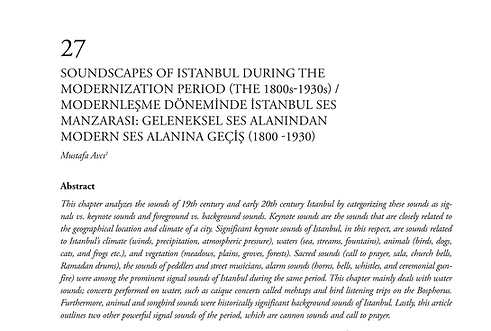
6. Soundscapes of Istanbul During the Modernization Period (the 1800s-1930s)
Modernleşme Döneminde İstanbul Ses Manzarası: Geleneksel Ses Alanından Modern Ses Alanına Geçiş (1800-1930)
Abstract
This chapter analyzes the sounds of 19th century and early 20th century Istanbul by categorizing these sounds as signals vs. keynote sounds and foreground vs. background sounds. Keynote sounds are the sounds that are closely related to the geographical location and climate of a city. Significant keynote sounds of Istanbul, in this respect, are sounds related to Istanbul's climate (winds, precipitation, atmospheric pressure), waters (sea, streams, fountains), animals (birds, dogs, cats, and frogs etc.), and vegetation (meadows, plains, groves, forests). Sacred sounds (call to prayer, sala, church bells, Ramadan drums), the sounds of peddlers and street musicians, alarm sounds (horns, bells, whistles, and ceremonial gunfire) were among the prominent signal sounds of Istanbul during the same period. This chapter mainly deals with water sounds; concerts performed on water, such as caique concerts called mehtaps and bird listening trips on the Bosphorus. Furthermore, animal and songbird sounds were historically significant background sounds of Istanbul. Lastly, this article outlines two other powerful signal sounds of the period, which are cannon sounds and call to prayer.
bottom of page